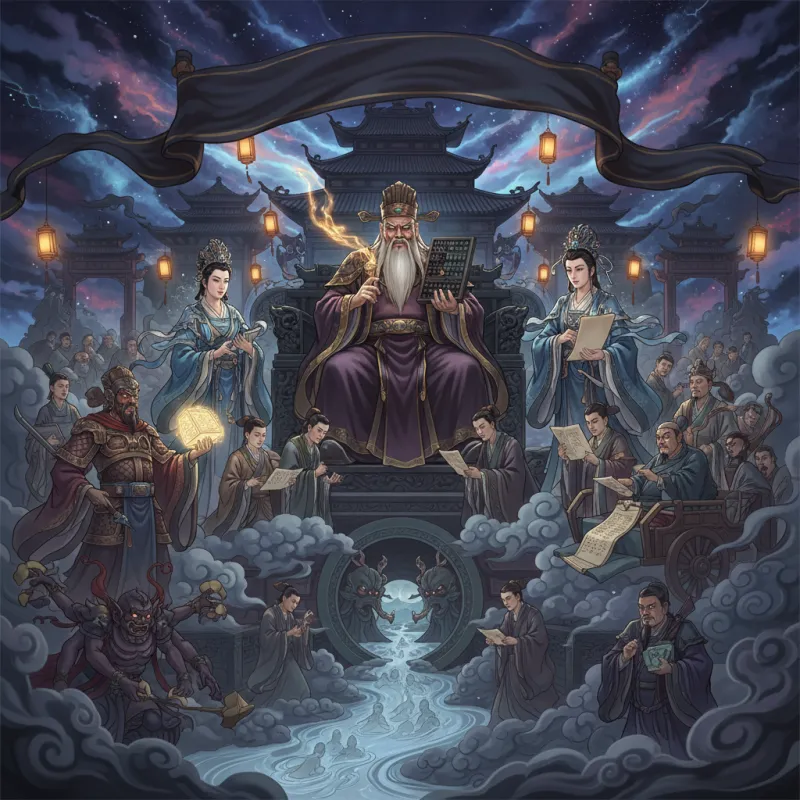
Every Chinese city has a mayor—and a divine one too. While the mortal official handles taxes and traffic, the City God (城隍, chénghuáng) manages something far more consequential: the souls of the dead, the moral ledger of the living, and the invisible bureaucracy that bridges this world and the next. These aren't remote celestial beings dwelling in clouds. They're former humans—upright magistrates, virtuous scholars, loyal generals—promoted to godhood and assigned to specific zip codes in the afterlife's vast administrative system.
The Divine Civil Service Exam
Here's what makes City Gods peculiar in the Chinese pantheon: they're appointed, not born divine. The Jade Emperor (玉皇大帝, Yùhuáng Dàdì), heaven's supreme bureaucrat, selects them based on merit—usually from deceased officials who governed with exceptional integrity during their mortal lives. It's the ultimate posthumous promotion, a celestial civil service that mirrors the imperial examination system that dominated Chinese governance for over a millennium.
Take Zhou Xin, the City God of Shanghai. He was a 14th-century magistrate known for refusing bribes and personally investigating cases rather than delegating to corrupt underlings. After his death during the Yuan Dynasty, locals began worshipping at his tomb. Eventually, the Jade Emperor made it official, and Zhou received his divine appointment. This pattern repeats across China—the City God of Beijing was once a Ming Dynasty general, while Hangzhou's protector was a Tang Dynasty poet-official who drowned himself rather than serve a corrupt regime.
The selection criteria reveal what Chinese culture values: not mystical powers or martial prowess, but administrative competence, moral rectitude, and genuine concern for common people. City Gods are middle managers in the cosmic hierarchy, reporting upward to regional deities and ultimately to the Jade Emperor, while supervising local land gods (土地公, tǔdì gōng) and minor spirits below them.
Jurisdiction: This World and the Next
A City God's responsibilities split between two realms. In the mortal world, they're supposed to prevent disasters, ensure good harvests, and maintain social harmony. Drought? Petition the City God. Plague? Same. Bandit raids? The City God should have seen it coming. This explains why City God temples (城隍廟, chénghuáng miào) were often located near government offices—the divine and secular authorities were meant to collaborate.
But the real action happens after death. City Gods serve as the first stop in the underworld's judicial process. When someone dies, their soul appears before the local City God for an initial judgment. The deity reviews the person's life using detailed records maintained by spirit clerks—every good deed, every petty cruelty, every broken promise, all documented. Based on this audit, the City God determines whether the soul proceeds to the Ten Courts of Hell for further judgment or receives immediate assignment to their next reincarnation.
This isn't arbitrary divine whim. City Gods follow strict bureaucratic protocols, complete with paperwork. Temple murals often depict them surrounded by assistants holding scrolls and ledgers, looking less like wrathful judges and more like overworked accountants during tax season. The underworld runs on documentation, and City Gods are the intake officers processing each soul's file.
The Temple as Government Office
Visit a City God temple, and you'll notice something unusual: it looks like a traditional Chinese government compound. There's a main hall where the deity sits in official robes and a magistrate's hat, flanked by attendants holding the tools of bureaucratic authority—seals, writing brushes, record books. Side halls house the deity's subordinates: the Ox-Head and Horse-Face guards (牛頭馬面, niútóu mǎmiàn) who escort souls to judgment, the Day and Night Wandering Gods (日夜遊神, rìyè yóushén) who patrol the city recording human behavior, and various clerks managing the celestial filing system.
The Shanghai City God Temple, built in 1403, exemplifies this architectural theology. Its layout mirrors the yamen (government office) where mortal magistrates worked. Petitioners would approach the main hall just as they would approach a living official, presenting written requests for divine intervention. The temple even had a side hall functioning as a divine prison, where particularly troublesome ghosts were supposedly detained pending judgment.
During the Ming and Qing dynasties, newly appointed mortal magistrates would visit the City God temple before assuming office, essentially introducing themselves to their supernatural counterpart. Some even left their official seals overnight in the temple, symbolically sharing authority with the deity. This wasn't mere superstition—it was acknowledgment that governance operated on multiple planes simultaneously.
Festival of the Dead Bureaucrat
The City God's birthday celebration reveals how these deities functioned in community life. Unlike the solemn rituals for remote celestial beings, City God festivals were raucous civic affairs. The deity's statue would be paraded through city streets in an elaborate sedan chair, accompanied by performers dressed as the god's supernatural staff—demons, judges, executioners, and clerks, all in full costume.
These processions served multiple purposes. They allowed the City God to inspect his jurisdiction, noting which neighborhoods needed divine attention. They reminded residents that moral behavior had consequences, as actors portraying punished souls would stumble through the streets in chains, displaying placards listing their sins. And they reinforced social cohesion—everyone from merchants to beggars participated, united in honoring their shared supernatural administrator.
The Shanghai City God's birthday on the third day of the fifth lunar month once drew hundreds of thousands of participants. Opera performances, puppet shows, and food stalls transformed the temple district into a combination religious festival and street fair. The Qing Dynasty government tried repeatedly to ban these celebrations as disorderly, but they persisted because they fulfilled a need that official Confucian rituals couldn't: they made the invisible bureaucracy of the afterlife tangible and participatory.
Decline and Persistence
The Communist revolution of 1949 hit City God worship hard. Temples were closed, repurposed, or destroyed during the Cultural Revolution. The entire concept—divine bureaucrats judging souls—contradicted materialist ideology. Many temples became factories, warehouses, or schools. The Shanghai City God Temple survived by becoming a commercial shopping district, its religious function suspended for decades.
Yet City Gods proved surprisingly resilient. When religious restrictions eased in the 1980s, worship quietly resumed. Temples reopened, often with government support as tourist attractions. Elderly worshippers who remembered the old rituals taught younger generations. Today, City God temples across China and in overseas Chinese communities continue operating, though their role has shifted.
Modern petitioners still burn incense and present offerings, but they're more likely to pray for business success or children's exam performance than for favorable judgment in the afterlife. The bureaucratic theology remains—people still address the City God with the formal language used for government officials—but the cosmic civil service has adapted to contemporary concerns. Some temples even accept online prayers and digital offerings, bringing the divine bureaucracy into the internet age.
The Bureaucrat as Spiritual Ideal
What makes City Gods enduringly fascinating is what they reveal about Chinese religious imagination. Rather than transcendent beings beyond human comprehension, these deities are recognizably human—former officials who earned their positions through competence and virtue. They're not worshipped for their power but respected for their fairness and administrative skill.
This reflects a distinctly Chinese approach to the divine: the universe operates like a well-run government, with clear hierarchies, defined responsibilities, and accountability. Even death doesn't escape bureaucracy—it just moves you to a different department. The Underworld isn't chaos or arbitrary punishment; it's an extension of the orderly system that (ideally) governed mortal life.
City Gods also embody the Confucian ideal that good governance requires moral character. They're not distant judges but local protectors who once walked the same streets as their worshippers. Their temples stand as reminders that authority—whether mortal or divine—carries responsibility, and that the best leaders are those who serve rather than dominate.
In a tradition filled with warrior gods, immortal sages, and cosmic buddhas, the City God remains stubbornly mundane: a middle manager doing paperwork, a local official trying to keep his jurisdiction running smoothly, a bureaucrat who happens to be dead. And perhaps that's precisely why they've endured—because they represent not the extraordinary, but the essential work of maintaining order in a complex world, one soul at a time.
Related Reading
- The City God System: Local Government of the Spirit World
- Folk Gods of China: The Deities Your Grandmother Prays To
- Caishen: The God of Wealth and How to Welcome Prosperity
- Guanyin: The God Who Became a Goddess (And Why Nobody Minds)
- The Kitchen God: Heaven's Spy in Every Chinese Home
- Ox-Head and Horse-Face: The Underworld's Enforcers
- Guanyin: The Goddess of Mercy Who Hears Every Cry
- The Quest for the Elixir of Life: From Emperor Qin to Modern Fiction