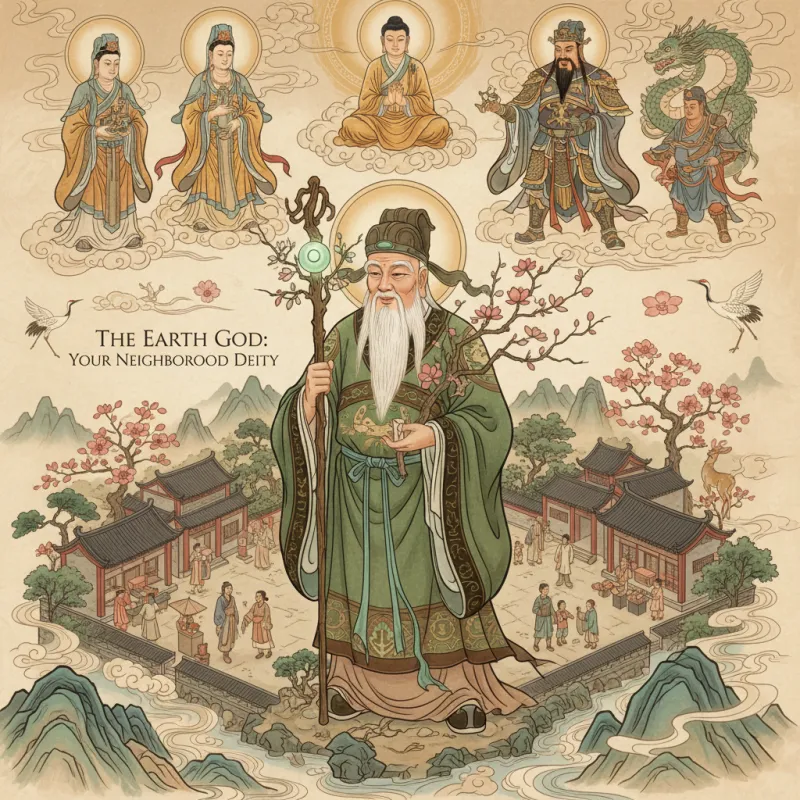
Walk into any traditional Chinese neighborhood—whether it's a narrow alley in old Taipei, a village square in Fujian, or a corner shop in Singapore's Chinatown—and you'll spot him before you even realize you're looking. A small red shrine tucked between buildings. A stone tablet under a banyan tree. Sometimes just a painted face on a rock with a few sticks of incense stuck in a rusty can. This is Tudi Gong (土地公 Tǔdì Gōng), the Earth God, and he's probably the most overworked, underpaid deity in the entire Chinese pantheon.
The Celestial Middle Manager Nobody Talks About
Here's the thing about Tudi Gong: he ranks dead last in heaven's bureaucracy. If the Jade Emperor is the CEO running the cosmic corporation, Tudi Gong is the local branch manager handling complaints about noisy neighbors and lost chickens. His jurisdiction? Usually just one village, sometimes a single street, occasionally even a specific building. The Ming dynasty novel Fengshen Yanyi (封神演義 Fēngshén Yǎnyì) doesn't even bother giving him a backstory—he's just there, doing his job, like middle management everywhere.
But here's what makes him fascinating: despite his low rank, he's the most frequently worshipped deity in Chinese folk religion. Not Guanyin. Not Guan Yu. Not even the Kitchen God. Tudi Gong gets daily offerings, constant prayers, and more shrines per capita than any other god. Why? Because he's local. He's accessible. He actually shows up to work.
From Aristocratic Sacrifice to Neighborhood Watchman
The Earth God wasn't always this democratic. During the Zhou dynasty (1046-256 BCE), worshipping the earth was an exclusive privilege of the emperor and nobility. They performed elaborate she (社 shè) rituals—grand state ceremonies involving animal sacrifices and formal protocols. The common people? They weren't invited.
This changed during the Han dynasty (206 BCE - 220 CE) when Confucian scholars started promoting the idea that every community should have its own earth altar. By the Tang dynasty (618-907 CE), the transformation was complete. The abstract concept of "earth" had become personified as Tudi Gong—a grandfatherly figure with a white beard, often depicted holding a gold ingot and accompanied by his wife, Tudi Po (土地婆 Tǔdì Pó). The aristocratic ritual had become a neighborhood institution.
What Does an Earth God Actually Do?
Tudi Gong's job description is surprisingly specific. He's responsible for the prosperity and safety of his designated territory. Farmers pray to him for good harvests. Merchants ask for business success. Parents request protection for their children. He's also the local record-keeper, maintaining files on every resident's good and bad deeds—information he reports upward to the City God during annual reviews.
But his most important function? He's the intermediary between the living and the dead. When someone dies, their soul must first report to the local Tudi Gong before proceeding to the underworld. He's essentially the intake officer for the afterlife, which explains why funeral rituals always include offerings to him. In rural Taiwan, families still burn paper money and spirit houses at the nearest Earth God shrine within days of a death, ensuring their deceased relative gets proper processing.
The Qing dynasty text Yuewei Caotang Biji (閱微草堂筆記 Yuèwēi Cǎotáng Bǐjì) by Ji Yun contains dozens of stories about Tudi Gong intervening in local affairs—revealing hidden treasures, warning about disasters, even helping solve crimes. In one tale, an Earth God appears in a magistrate's dream to point out where a murdered body is buried. In another, he prevents a house fire by waking the residents. He's not performing cosmic miracles; he's handling neighborhood emergencies.
The Shrine on Every Corner
Earth God shrines are everywhere, but they're rarely impressive. Unlike the grand temples dedicated to major deities, Tudi Gong's shrines are deliberately modest. Many are just small stone structures, barely waist-high, with a simple statue or tablet inside. Some are built into the base of old trees. Others occupy awkward spaces between buildings, like spiritual afterthoughts.
This humility is intentional. Tudi Gong is meant to be approachable, not intimidating. His shrines don't require ritual purity or formal dress. You can stop by in your work clothes, light a stick of incense, and have a quick chat about your problems. No appointment necessary. No priest required.
In Hong Kong, there's a famous Earth God shrine built into the base of a massive fig tree in Lam Tsuen. People write wishes on red paper, tie them to the tree's branches, and toss them upward—the higher they stick, the more likely the wish will be granted. It's become a tourist attraction, but locals still treat it as a functioning shrine, bringing offerings on the first and fifteenth of each lunar month.
The Second and Sixteenth: Earth God Days
Traditional Chinese communities observe two Earth God festivals each month—on the second and sixteenth days of the lunar calendar. These aren't major holidays with dragon dances and fireworks. They're quiet, practical affairs. Shopkeepers bring offerings to the shrine at the corner. Farmers leave rice and fruit at the field's edge. The offerings are simple: incense, tea, rice wine, sometimes a few pieces of fruit or a plate of vegetarian food.
The biggest celebration happens on the second day of the second lunar month—Tudi Gong's official birthday (土地公誕 Tǔdì Gōng Dàn). In rural areas, this is a significant community event. Villages organize processions, opera performances, and communal feasts. In Fujian and Taiwan, it's traditional to eat "run bing" (潤餅 rùnbǐng)—spring roll-like wraps filled with vegetables and meat—as offerings and festival food.
But even this celebration maintains a local, intimate character. Unlike the massive pilgrimages to Mazu temples or the elaborate ceremonies for the Jade Emperor's birthday, Tudi Gong's festival is a neighborhood affair. It's about community cohesion, not religious spectacle.
The God Who Never Retires
Here's something peculiar about Tudi Gong: he's not immortal in the traditional sense. According to folk belief, Earth Gods are actually promoted from deceased humans who lived virtuous lives. When someone dies with exceptional merit—a benevolent landlord, a righteous official, a community leader—they might be appointed as the local Earth God. It's a civil service position in the afterlife.
This means Tudi Gong can be replaced. If a particular Earth God does his job well, he might get promoted to City God or another higher position. If he performs poorly, he can be demoted or reassigned. The Qing dynasty scholar Yuan Mei recorded stories of Earth Gods being fired for incompetence—their shrines abandoned, their territories reassigned.
This bureaucratic flexibility makes Tudi Gong uniquely relatable. He's not an eternal, unchanging cosmic force. He's a working stiff trying to do his job well enough to get promoted, just like everyone else. When people pray to him, they're not supplicating an all-powerful deity; they're filing a request with the local administrator. It's a fundamentally practical relationship.
Why the Lowest God Matters Most
The genius of Tudi Gong lies in his ordinariness. Chinese folk religion is full of spectacular deities—warrior gods, celestial emperors, enlightened bodhisattvas. But Tudi Gong represents something more fundamental: the sacralization of everyday space. He transforms ordinary places—street corners, village squares, field boundaries—into sites of spiritual significance.
This matters because it makes religion accessible. You don't need to travel to a famous temple or wait for a festival. The divine is right there, at the end of your street, available whenever you need it. This democratization of worship is one of Chinese folk religion's most distinctive features, and Tudi Gong is its primary vehicle.
In modern cities, as traditional communities fragment and old neighborhoods disappear, Earth God shrines are often the last remnants of folk religious practice. A gleaming shopping mall might have a tiny Tudi Gong shrine tucked in a corner, maintained by elderly shopkeepers who remember when the area was still a village. These shrines are cultural anchors, connecting present to past, urban to rural, individual to community.
The Earth God will never be the most powerful deity, the most famous, or the most philosophically profound. But he might be the most essential—the god who shows up, does the work, and keeps the neighborhood running. In a pantheon of cosmic bureaucrats, that's worth more than all the celestial titles combined.
Related Reading
- The City God System: Local Government of the Spirit World
- Guanyin: The God Who Became a Goddess (And Why Nobody Minds)
- Exploring Chinese Deities and Immortals: Insights into Daoist and Buddhist Folk Gods
- The Kitchen God: Heaven's Spy in Every Chinese Home
- Unveiling the Rich Tapestry of Chinese Deities and Immortals in Folk Religion
- Unveiling the Rich Tapestry of Chinese Deities and Immortals
- Chinese Rituals for the Dead: A Practical Guide to Ancestor Worship
- The Underworld Gods: Who Runs Chinese Hell