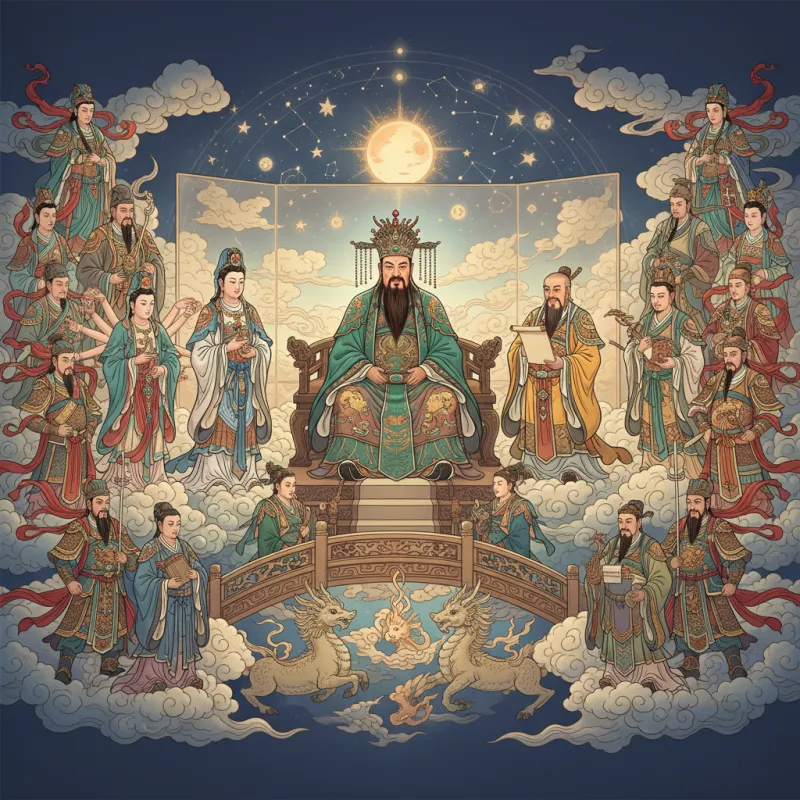
Picture this: a celestial bureaucrat sits on a throne of jade, shuffling through reports from dragon kings, mountain gods, and kitchen spirits, deciding who gets promoted to immortality and who gets demoted to earthly punishment. This isn't some fantasy novel—it's the daily routine of the Jade Emperor (玉皇大帝, Yùhuáng Dàdì), the supreme deity who runs Heaven like a cosmic civil service. And if you think that sounds oddly specific and bureaucratic for a god, well, you're starting to understand how Chinese cosmology works.
The Bureaucrat Who Became God
Here's what most introductions to the Jade Emperor get wrong: they treat him like he's always been there, some eternal fixture of the Chinese pantheon. The truth is far more interesting. The Jade Emperor is actually a relative newcomer to the divine scene, not appearing in major texts until the Tang Dynasty (618-907 CE), and not really hitting his stride until the Song Dynasty (960-1279 CE) when Emperor Zhenzong gave him an official promotion—yes, a human emperor promoting a heavenly one—to "Supreme Jade Emperor of the Heavenly Golden Palace" (太上開天執符御曆含真體道昊天玉皇上帝, Tàishàng Kāitiān Zhífú Yùlì Hánzhēn Tǐdào Hàotiān Yùhuáng Shàngdì).
Before the Jade Emperor's rise, other deities held the top spot. The ancient Shangdi (上帝) ruled in Shang Dynasty texts, while Tian (天, Heaven) dominated Zhou Dynasty thought. The Jade Emperor essentially climbed the corporate ladder of Chinese religion, absorbing and superseding earlier sky gods through a combination of Daoist systematization and imperial endorsement. It's a reminder that even divine hierarchies aren't immune to historical change and political maneuvering.
Heaven as Imperial China, But Make It Eternal
The genius of the Jade Emperor concept lies in its mirror-image relationship with earthly governance. Heaven in Chinese cosmology isn't some abstract spiritual realm—it's a fully functioning government complete with ministries, departments, and endless paperwork. The Jade Emperor presides over this celestial bureaucracy much like the human emperor ruled China, with one crucial difference: his administration is supposed to actually work.
Under the Jade Emperor's rule, you'll find the Department of Thunder (雷部, Léi Bù), the Ministry of Time, the Bureau of Epidemics, and officials managing everything from rainfall to reincarnation. The Dragon Kings report to him on oceanic affairs. The City God of each municipality sends up reports on local morality. Even the humble Kitchen God (灶君, Zàojūn) files annual reviews on household behavior. It's governance taken to its logical extreme—or perhaps its absurd conclusion, depending on your perspective.
This bureaucratic model reveals something profound about Chinese religious thought: the universe operates on principles of order, hierarchy, and moral accountability. Chaos isn't the natural state to be overcome; rather, proper administration and ethical conduct maintain cosmic harmony. The Jade Emperor doesn't create or destroy on a whim—he administers, adjudicates, and maintains balance.
The Journey from Mortal to Supreme Deity
Unlike many supreme deities who simply exist from the beginning of time, the Jade Emperor has an origin story, and it's a doozy. According to the Jade Emperor's Original Life Scripture (玉皇本行集經, Yùhuáng Běnxíng Jíjīng), he started as a prince of the Kingdom of Pure Felicity and Majestic Heavenly Lights and Ornaments. When his father died without an heir willing to rule, the prince instead retreated to a mountain cave to cultivate the Dao.
The texts claim he spent 3,200 trials proving his compassion and 800 trials demonstrating his wisdom before achieving immortality. Then—and this is where it gets really ambitious—he spent another 100 million years cultivating himself before finally becoming the Jade Emperor. That's dedication to self-improvement that makes modern productivity gurus look like slackers.
This backstory matters because it establishes the Jade Emperor's legitimacy through merit rather than mere divine fiat. He earned his position through cultivation (修行, xiūxíng), the same path theoretically available to any dedicated practitioner. It's a fundamentally Daoist concept: even the highest god achieved his status through spiritual work, not because he was born special. This makes him both more relatable and more authoritative—he's been where mortals are and transcended it.
The Jade Emperor in Popular Culture and Literature
If you want to see the Jade Emperor in action, crack open Journey to the West (西遊記, Xīyóujì), the 16th-century novel that's basically China's answer to the Odyssey meets Monty Python. Here, the Jade Emperor comes across as somewhat... ineffectual. When Sun Wukong, the Monkey King, crashes the Peach Banquet and steals the pills of immortality, the Jade Emperor's response is to send increasingly powerful generals after him, all of whom fail spectacularly. Eventually, he has to call in the Buddha for help.
This portrayal might seem disrespectful, but it actually reflects a sophisticated understanding of divine hierarchy. The Jade Emperor rules through proper channels and protocol—he's the administrator, not the warrior. When faced with chaos that breaks all rules (like an immortal monkey who refuses to stay in his assigned role), he needs specialists. It's not weakness; it's delegation.
Modern Chinese television and film continue to feature the Jade Emperor, though often with more gravitas than Wu Cheng'en gave him. He appears in countless period dramas, animated films, and even video games, usually as the ultimate authority figure whose decisions set plots in motion. His visual representation has become standardized: elaborate robes, a flat-topped imperial crown, a long beard, and that throne of jade, often surrounded by clouds and attended by celestial officials.
Worship and Ritual Practice
Despite his supreme status, the Jade Emperor isn't the most commonly worshipped deity in Chinese folk religion. That honor goes to more specialized gods like Guanyin or Guan Yu, deities who handle specific problems. The Jade Emperor is more like the CEO you only approach for the really big issues—or during his birthday.
And what a birthday it is. The ninth day of the first lunar month marks the Jade Emperor's birthday (天公生, Tiāngōng Shēng), celebrated with particular enthusiasm in Fujian and Taiwan. Families stay up past midnight, offering elaborate sacrifices of fruit, flowers, and specially prepared foods. The offerings are placed on a high table—you don't put the supreme deity's altar at ground level—and include sugarcane stalks to symbolize the ladder to Heaven.
In Daoist temples, the Jade Emperor typically occupies the central position in the main hall, though interestingly, he's often flanked or even superseded by the Three Pure Ones (三清, Sānqīng), the highest deities in Daoist cosmology proper. This creates a fascinating theological tension: is the Jade Emperor supreme, or is he the administrative head while the Three Pure Ones represent deeper metaphysical principles? The answer depends on which text you read and which temple you visit—Chinese religion has never been big on enforced orthodoxy.
The Jade Emperor's Enduring Relevance
What keeps the Jade Emperor relevant in the 21st century isn't his power—it's what he represents. In an age of corporate hierarchies, government bureaucracies, and complex organizational systems, the idea of a cosmic administrator who actually maintains justice and order holds a certain appeal. He's the fantasy of bureaucracy that works, of authority that's truly legitimate because it's earned and exercised with wisdom.
The Jade Emperor also embodies a distinctly Chinese approach to the divine: gods aren't incomprehensible others but rather perfected versions of human potential. They have jobs, responsibilities, and hierarchies. They can be petitioned, reasoned with, and yes, even occasionally fooled by clever mortals (just ask Sun Wukong). This makes the divine realm accessible in a way that more transcendent concepts of deity don't.
For diaspora communities, the Jade Emperor serves as a cultural touchstone, a figure that connects them to ancestral traditions and shared stories. His birthday celebrations bring families together, his image adorns temples from San Francisco to Singapore, and his stories continue to be retold in new media and formats.
Beyond the Throne
The Jade Emperor reminds us that Chinese cosmology isn't about a single, simple hierarchy with one god at the top. It's a complex, sometimes contradictory system where different deities hold supreme positions depending on context, tradition, and philosophical framework. The Jade Emperor rules Heaven's bureaucracy, but the Three Pure Ones represent the Dao itself. The Buddha exists in a parallel system of enlightenment. Local gods handle immediate concerns while cosmic deities manage universal principles.
This multiplicity isn't a bug—it's a feature. It reflects the reality of Chinese religious life, where people draw from Daoism, Buddhism, Confucianism, and folk traditions as needed, without feeling compelled to choose one exclusive truth. The Jade Emperor sits at the center of this web, not as a jealous god demanding sole worship, but as the administrator who keeps the whole complex system running.
And perhaps that's the most profound lesson the Jade Emperor offers: sometimes what the cosmos needs isn't a warrior god or a creator deity, but a competent manager who shows up, does the work, and keeps everything from falling into chaos. It's not glamorous, but someone's got to do it—even in Heaven.
Related Reading
- Celestial Masters and Heavenly Generals: Daoism's Divine Warriors — Shenxian Perspective
- The Mountain Gods: Nature Deities in the Daoist Pantheon — Shenxian Perspective
- The Three Pure Ones: Supreme Deities of Daoism — Shenxian Perspective
- The Daoist Pantheon: A Who's Who of Chinese Gods
- The Three Pure Ones: Supreme Deities of Taoism
- Sun Wukong as a Real Deity: Temples and Worship of the Monkey God
- The Chinese Religious Calendar: When to Worship What
- Burning Ghost Money: The Complete Guide to Afterlife Offerings