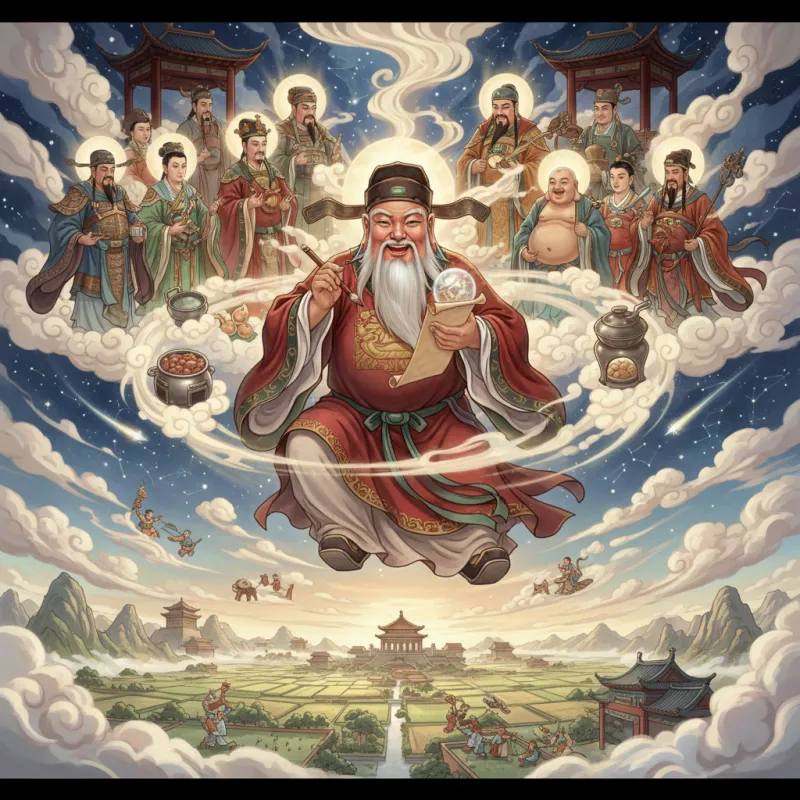
Every year, just before the Lunar New Year, millions of Chinese families perform a peculiar ritual: they smear honey on the lips of a paper portrait hanging above their stove, then burn it to send the image skyward. This isn't vandalism—it's bribery. The target? Zaojun (灶君, Zàojūn), the Kitchen God, who's about to fly to Heaven and report on everything your family did wrong this year. Better make sure his mouth is sweet.
The Divine Snitch in Your Kitchen
Zaojun occupies one of the most intimate positions in the Chinese pantheon. Unlike the remote Jade Emperor who rules from the highest heavens, or the City God who governs entire municipalities, the Kitchen God lives right there in your home, watching. Every quarrel between spouses, every act of filial piety or disrespect, every meal prepared or wasted—he sees it all. His official title, Siming Zaojun (司命灶君, Sīmìng Zàojūn), literally means "Kitchen Lord Who Controls Destiny," and that's not hyperbole. The report he delivers to the Jade Emperor on the 23rd or 24th day of the twelfth lunar month directly influences your family's fortune for the coming year.
The Kitchen God's surveillance isn't just spiritual paranoia. It's codified in texts like the Taishang Ganying Pian (太上感應篇, Treatise of the Exalted One on Response and Retribution), which explicitly states that household deities record human transgressions. Some versions claim Zaojun has two assistants: a wife who monitors the women's activities and a subordinate who tracks the men's behavior. You're never truly alone.
From Mortal Failure to Divine Bureaucrat
The Kitchen God's origin story is deliciously ironic—he earned his divine position through spectacular failure as a human. The most popular version, recorded in various Ming and Qing dynasty texts, tells of Zhang Lang (張郎, Zhāng Láng), a man who abandoned his virtuous wife for a younger woman. When his fortune collapsed and he was reduced to begging, he stumbled into his ex-wife's home, not recognizing her. She fed him generously, and when he finally realized who she was, shame overwhelmed him. He threw himself into the kitchen fire and died.
The Jade Emperor, moved by the wife's forgiveness and Zhang Lang's final moment of remorse, appointed him Kitchen God—a position where he could observe family dynamics and perhaps prevent others from making his mistakes. It's a redemption arc with a twist: the reformed sinner becomes the judge.
Other versions identify Zaojun as Suji (蘇吉, Sūjí), a loyal official from the Zhou dynasty, or even as a primordial fire deity predating organized religion. The multiplicity of origin stories actually strengthens his cult—every region, every family, could adopt the version that resonated most while maintaining the core function: domestic surveillance for cosmic purposes.
The Annual Performance Review
The Kitchen God's journey to Heaven isn't a casual trip. On the 23rd day of the twelfth lunar month in northern China (the 24th in the south—even divine bureaucracy has regional variations), Zaojun ascends to deliver his annual report. This "Little New Year" (小年, Xiǎonián) triggers a household frenzy. Families offer sticky foods—maltose candy, glutinous rice cakes, honey—ostensibly to "sweeten his words" but really to glue his mouth shut. Some traditions include wine to get him drunk enough to forget the bad parts. It's simultaneously reverent and cheeky, a perfect example of Chinese folk religion's practical approach to the divine.
The offerings reveal deeper anxieties. Families present the Kitchen God with a paper horse and provisions for his journey, treating him like an official traveling on imperial business. Because that's exactly what he is—a low-level bureaucrat in the celestial administration, complete with the power to make or break your year through his report. The Jade Emperor reads these reports and adjusts each family's allotment of fortune, health, and longevity accordingly.
On New Year's Eve, families paste up a new image of Zaojun, welcoming him back from Heaven. The fresh portrait symbolizes a clean slate, a new year of observation beginning. The cycle repeats, endless as the turning seasons.
The Kitchen God in Literature and Popular Culture
Zaojun appears throughout Chinese literature, often as a plot device for cosmic justice. In Journey to the West, though not a major character, household gods like him represent the omnipresent divine bureaucracy that even the rebellious Monkey King cannot escape. The Investiture of the Gods (Fengshen Yanyi, 封神演義) includes kitchen deities among the newly appointed gods, emphasizing their role in the post-apotheosis celestial order.
More tellingly, Zaojun features in countless folk tales and local operas where he serves as the ultimate witness. A husband murders his wife? The Kitchen God saw it. A daughter-in-law secretly cares for her abusive mother-in-law? Zaojun reports her virtue. These stories reinforced social norms through supernatural surveillance—Big Brother with a beard and a taste for honey.
Modern Chinese culture maintains an ambivalent relationship with the Kitchen God. Urban apartments often lack traditional kitchens, and younger generations may view the custom as superstition. Yet during Lunar New Year, even skeptical millennials might find themselves participating in the ritual at their grandparents' homes, maintaining tradition if not belief. The Kitchen God persists as cultural memory, a reminder of when every home had a divine spy and every action carried cosmic weight.
The Theology of Domestic Surveillance
What makes Zaojun fascinating isn't just his function but what he reveals about Chinese religious philosophy. Unlike the Christian concept of an omniscient God who sees all, Chinese folk religion distributes surveillance across a vast bureaucracy. The Kitchen God handles households, the City God manages urban areas, the Earth God (Tudi Gong, 土地公) oversees local territories, and so on up the hierarchy. It's surveillance through specialization, divine middle management.
This system reflects Confucian social organization projected onto the cosmos. Just as earthly emperors relied on officials to govern distant provinces, the Jade Emperor needs local deities to monitor the mortal realm. Zaojun's reports aren't just spiritual assessments—they're administrative documents in a cosmic bureaucracy that mirrors earthly government.
The Kitchen God also embodies the Daoist principle that the microcosm reflects the macrocosm. The kitchen, as the source of nourishment and the heart of family life, becomes a miniature cosmos with its own presiding deity. Control the kitchen, maintain harmony there, and you influence your family's cosmic standing. It's practical theology: fix your home life, and Heaven takes notice.
Worshipping the Watcher
Traditional Kitchen God worship involves more than the annual send-off. Devout families offer incense daily, present food on the first and fifteenth of each lunar month, and maintain his image in pristine condition. The portrait typically shows Zaojun with his wife (or wives, in some versions), surrounded by auspicious symbols and the characters "Heaven's Ear and Earth's Eye" (天耳地眼, Tiān'ěr Dìyǎn) or "Head of the Eastern Kitchen, Lord of Destiny" (東廚司命, Dōngchú Sīmìng).
The placement matters. The Kitchen God's image must face the stove but also command a view of the kitchen entrance—optimal positioning for surveillance. Some families include a small couplet: "Heaven speaks good things, Earth ensures peace" (上天言好事,下界保平安, Shàngtiān yán hǎoshì, xiàjiè bǎo píng'ān). It's both prayer and reminder: we're watching you watch us.
The ritual's genius lies in its psychological impact. Knowing the Kitchen God observes everything encourages better behavior—or at least more discrete misbehavior. It's social control through internalized surveillance, making people police themselves because a deity is always watching. Foucault would have a field day analyzing Zaojun's panopticon kitchen.
The Kitchen God Today
In contemporary China, Kitchen God worship has declined but not disappeared. Rural areas and traditional families maintain the practice, while urban revival movements have sparked renewed interest among those seeking cultural roots. Temples dedicated to Zaojun exist throughout China and in overseas Chinese communities, serving as cultural anchors for diaspora populations.
The Kitchen God's evolution continues. Some modern interpretations emphasize his protective rather than punitive aspects, recasting him as a guardian who advocates for families rather than a snitch who reports them. This softer version appeals to contemporary sensibilities while maintaining ritual continuity.
Yet the original concept—a divine spy in every kitchen—remains culturally potent. It speaks to enduring questions about privacy, morality, and accountability. In an age of actual surveillance through smartphones and social media, Zaojun seems almost quaint. But he reminds us that the anxiety about being watched, about our private actions having public consequences, is ancient and perhaps universal.
Every time you see that faded portrait above a stove in a Chinese home, remember: you're looking at a bureaucrat, a spy, a reformed sinner, and a protector all at once. And he's definitely taking notes.
Related Reading
- The Earth God: Your Neighborhood Deity
- Unveiling the Rich Tapestry of Chinese Deities and Immortals in Folk Religion
- Caishen: The God of Wealth and How to Welcome Prosperity
- Guanyin: The God Who Became a Goddess (And Why Nobody Minds)
- The City God System: Local Government of the Spirit World
- The Four Heavenly Kings: Guardians at Every Temple Gate
- The Heavenly Court: How Chinese Heaven Is Organized
- Unveiling the Mystique of Chinese Animal Spirits in Daoist and Buddhist Beliefs