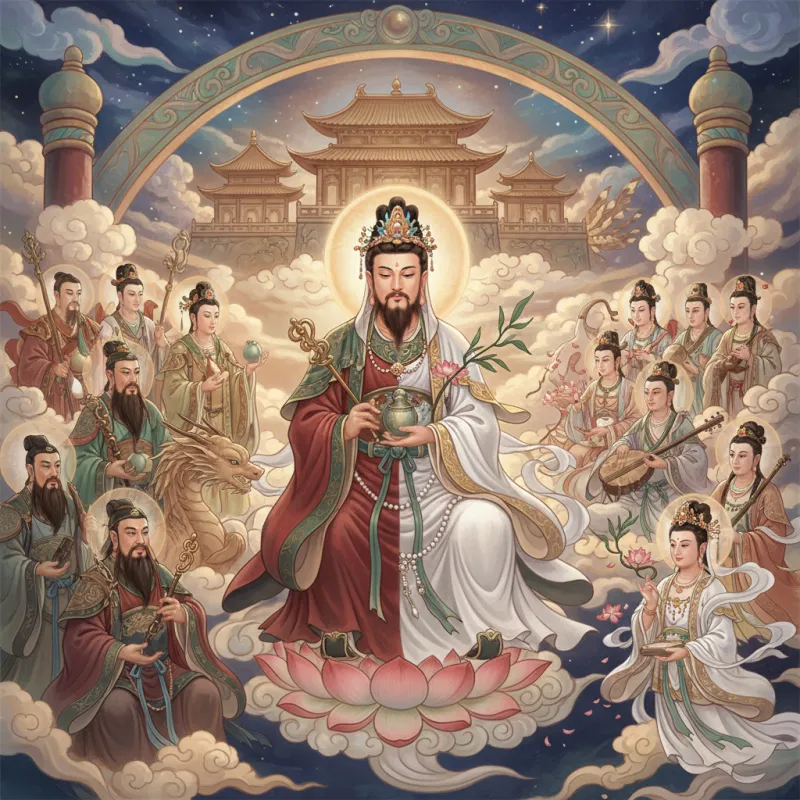
Picture this: A Buddhist deity crosses the Silk Road from India to China as a male bodhisattva. A thousand years later, he's become the most beloved goddess in East Asia, depicted as a graceful woman in flowing white robes, worshipped by millions who would be shocked to learn she was ever anything else. This isn't a mistake or mistranslation—it's one of the most successful religious transformations in human history, and it happened so smoothly that most devotees never questioned it.
The Original Avalokiteshvara
Avalokiteshvara (अवलोकितेश्वर) arrived in China during the early centuries CE as an unambiguously male bodhisattva. In Sanskrit, his name means "The Lord Who Looks Down [with Compassion]," and Indian Buddhist texts describe him with masculine pronouns and imagery. The Lotus Sutra, translated into Chinese around 406 CE by Kumarajiva, presents Avalokiteshvara as a powerful male figure who manifests in thirty-three different forms to save beings in distress.
Early Chinese depictions from the 5th and 6th centuries show Avalokiteshvara—now called Guanshiyin (观世音, Guānshìyīn, "Perceiver of the World's Sounds"), later shortened to Guanyin—with a thin mustache and masculine features. Cave temples at Dunhuang preserve these images: a slender male figure with Indian-style jewelry and robes. If you visit these caves today, you can trace the transformation decade by decade, watching the mustache fade and the features soften.
The Gradual Feminization
Between the 7th and 12th centuries, something remarkable happened. Guanyin's gender became increasingly ambiguous, then definitively female. This wasn't a sudden theological decision—no council of monks declared "Guanyin is now a goddess." Instead, popular devotion and artistic representation gradually transformed the deity.
The Tang Dynasty (618-907 CE) marks the transitional period. Statues from this era show Guanyin with softer features, more elaborate jewelry, and flowing robes that obscure body shape. By the Song Dynasty (960-1279 CE), the transformation was complete. Guanyin appeared as an elegant woman, often depicted in the "Water-Moon Guanyin" pose—seated gracefully on a rock by water, one leg pendant, radiating serene femininity.
The famous White-Robed Guanyin (白衣观音, Báiyī Guānyīn) iconography emerged during this period, showing her in pure white garments that became her signature look. This image proved so powerful that it essentially overwrote earlier masculine depictions in popular consciousness.
Why China Needed a Goddess
Chinese religion had a goddess problem—or rather, a lack of goddess problem. The Daoist pantheon included female immortals like Xiwangmu, but they were often stern, powerful, and somewhat distant figures. Confucian ideology emphasized patriarchal structures and offered no divine feminine role models. Buddhism arrived with its own patriarchal assumptions: the Buddha was male, most bodhisattvas were male, and some texts even suggested women needed to be reborn as men to achieve enlightenment.
But Chinese popular religion desperately wanted a compassionate mother figure. The role of mothers in Chinese family structure was paramount—they were the emotional center of the household, the ones you turned to in crisis. People needed a deity who embodied maternal compassion, who would listen to the prayers of women, children, and the desperate without judgment.
Guanyin filled this void perfectly. The Lotus Sutra already emphasized Avalokiteshvara's compassion and willingness to appear in whatever form was needed to save beings. Chinese devotees simply decided the form they needed was female. The text's promise that Guanyin would grant children to those who prayed sealed the association with motherhood and femininity.
The Princess Miaoshan Legend
By the 12th century, a fully developed origin story emerged that explained Guanyin's femininity: the legend of Princess Miaoshan (妙善, Miàoshàn). According to this tale, Miaoshan was a Chinese princess who refused to marry, insisting on becoming a Buddhist nun instead. Her father, furious, subjected her to terrible ordeals. She endured them all with perfect compassion, eventually sacrificing her own eyes and arms to create medicine that saved her father's life.
This act of filial piety and self-sacrifice so moved the heavens that she was transformed into the thousand-armed, thousand-eyed Guanyin. The story is completely apocryphal—no Indian Buddhist text mentions it—but it became canonical in Chinese Buddhism. It gave Guanyin a Chinese identity, rooted her in Confucian values of filial piety, and explained her femininity through a narrative Chinese audiences found deeply moving.
The Miaoshan legend appears in the Fragrant Mountain Precious Scroll and spread through popular literature, opera, and temple murals. Today, if you ask a Chinese devotee why Guanyin is female, they might tell you about Princess Miaoshan as if it were historical fact.
Multiple Guanyins, Multiple Genders
Here's where it gets interesting: Guanyin never completely lost masculine associations. In esoteric Buddhism and some temple traditions, male forms of Guanyin persisted. The Thousand-Armed Guanyin (千手观音, Qiānshǒu Guānyīn) is sometimes depicted with masculine features. In Tibet, Avalokiteshvara remained firmly male—the Dalai Lama is considered his incarnation.
Chinese Buddhism essentially developed multiple Guanyins for different contexts. The popular devotional Guanyin—the one ordinary people prayed to for children, safety, and mercy—was female. The esoteric ritual Guanyin in some monastic contexts retained masculine or androgynous qualities. This flexibility reflects Chinese religious pragmatism: whatever works for the devotee is correct.
Some scholars argue Guanyin is better understood as beyond gender, a transcendent being who appears in whatever form is most helpful. That's theologically sophisticated, but it misses the point. For the millions who burn incense before her statues, Guanyin is unambiguously female, and that femininity is essential to her appeal.
Why Nobody Minds
The remarkable thing about Guanyin's gender transformation is the absence of controversy. No one fought about it. No one declared it heresy. Buddhist monks didn't insist on preserving the "authentic" male Avalokiteshvara. The change happened because it met a genuine religious need, and Chinese Buddhism was flexible enough to accommodate it.
This flexibility distinguishes Chinese religion from more text-bound traditions. While Buddhist sutras were respected, they weren't treated as unchangeable law. If popular devotion moved in a different direction, the tradition adapted. The Lotus Sutra said Avalokiteshvara could appear in any form—well, Chinese devotees decided that form should be female, and the tradition said "sure, why not?"
Compare this to the rigid gender roles in many religious traditions, where any deviation from scriptural precedent sparks fierce debate. Chinese Buddhism simply shrugged and followed the devotees' lead. The result is a goddess who has brought comfort to countless millions for over a thousand years.
Guanyin Today
Modern Guanyin worship remains enormously popular throughout East Asia. She's the deity you pray to when you want children, when you're sick, when you're traveling, when you're afraid. Temples dedicated to Guanyin draw massive crowds, especially on her three festival days (her birthday, enlightenment day, and renunciation day).
The 108-meter statue of Guanyin on Hainan Island, completed in 2005, is one of the tallest statues in the world—and unmistakably female. Modern devotees would be genuinely confused if you told them Guanyin was originally male. That history has been so thoroughly overwritten that the female Guanyin feels eternal and inevitable.
This is how religions actually evolve—not through theological debates and official pronouncements, but through the accumulated choices of millions of devotees over centuries. Guanyin became a goddess because Chinese Buddhism needed a goddess, and the tradition was wise enough to let it happen. The result is one of the most beloved deities in human religious history, whose gender transformation tells us more about the living nature of religious tradition than any amount of doctrinal analysis ever could.
Related Reading
- Unveiling the Rich Tapestry of Chinese Deities and Immortals in Folk Religion
- Caishen: The God of Wealth and How to Welcome Prosperity
- Folk Gods of China: The Deities Your Grandmother Prays To
- City Gods: Divine Bureaucrats of the Underworld
- The Kitchen God: Heaven's Spy in Every Chinese Home
- Exploring the Rich Pantheon of Chinese Deities and Immortals in Daoism and Buddhism
- The Mountain Gods: Nature Deities in the Daoist Pantheon — Shenxian Perspective
- Discovering Nature Spirits in Chinese Mythology: Guardians of the Earth and Sky