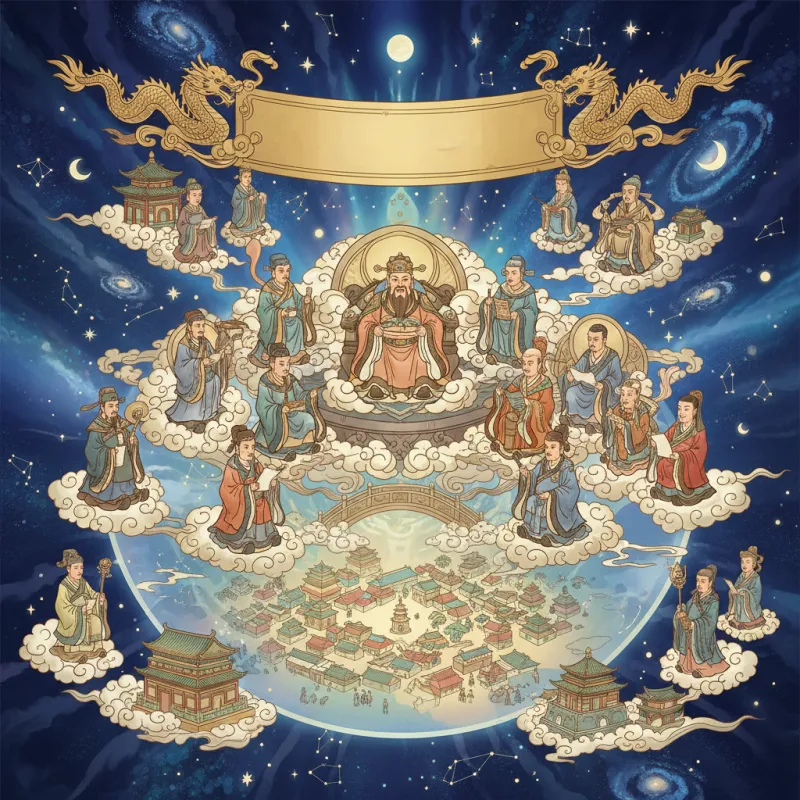
When the magistrate of a Chinese city took office, he didn't just report to the provincial governor — he also paid his respects to his supernatural counterpart, the City God, whose temple stood near the government offices. This wasn't mere superstition. The City God (城隍 Chénghuáng) commanded real authority over the spiritual welfare of every resident, maintained detailed records of their moral accounts, and could make or break a magistrate's career through divine intervention. For over a thousand years, China operated under a dual administration: one visible, one invisible, both equally bureaucratic.
The Divine Civil Service
The City God system represents Chinese pragmatism at its finest — why shouldn't the afterlife be organized as efficiently as the empire itself? Each city, county, and town had its own City God, appointed through a celestial bureaucracy that mirrored the earthly one with uncanny precision. Provincial capitals had higher-ranking City Gods than county seats. The City God of Beijing outranked all others, just as the emperor outranked all governors.
But here's where it gets interesting: City Gods weren't born into their positions. They were promoted. Most City Gods were historical figures — upright officials, military heroes, or virtuous scholars who had served their communities so well in life that the Jade Emperor (玉皇大帝 Yùhuáng Dàdì) appointed them to continue their service after death. The City God of Shanghai, for instance, was Qin Yubo, a Song Dynasty general who defended the city against invaders. Hangzhou's City God was Zhou Xin, a magistrate so incorruptible that locals petitioned for his deification after his death.
The appointment process itself was bureaucratic theater. Imperial decrees would officially recognize a spirit's promotion to City God status, complete with ceremonial titles and ranks. The Qing Dynasty even established a formal hierarchy: City Gods of provincial capitals held the rank of "Duke" (公 gōng), prefectural City Gods were "Marquis" (侯 hóu), and county City Gods were merely "Earl" (伯 bó). Performance reviews happened too — City Gods who failed to protect their cities from disaster could be demoted or dismissed, their tablets removed from temples in disgrace.
The Spiritual Police State
The City God's primary responsibility was maintaining order in both the living and dead populations of his jurisdiction. His staff included judges, clerks, runners, and the fearsome Black and White Impermanence (黑白无常 Hēibái Wúcháng) — supernatural police officers who arrested souls at the moment of death. Every temple had statues of these officials, creating a divine org chart that any bureaucrat would recognize.
The City God kept meticulous records. In his underworld office, ledgers tracked every resident's good and evil deeds, updated in real-time by invisible clerks. When someone died, the City God's runners would check the books, verify the death date matched the heavenly schedule, and escort the soul to the appropriate afterlife destination. Premature deaths, murders, and suicides created paperwork nightmares that required investigation and reports to higher authorities.
This surveillance extended to the living. City Gods were believed to patrol their territories at night, observing behavior and noting transgressions. The seventh lunar month, when ghosts roamed freely, was particularly busy — the City God had to manage both the living population and the temporary influx of visiting spirits. Temple festivals during this period weren't just celebrations; they were opportunities for residents to demonstrate their loyalty and petition for protection.
When Magistrates Met Gods
The relationship between earthly magistrates and City Gods was complex, sometimes cooperative, sometimes competitive. New magistrates performed elaborate ceremonies at the City God temple, essentially introducing themselves to their supernatural colleague. Some left their official seals overnight in the temple, symbolically sharing authority. Others wrote formal reports to the City God, updating him on administrative decisions.
But magistrates also held City Gods accountable. When disasters struck — floods, droughts, epidemics — officials would publicly rebuke the City God for failing in his duties. They might remove his statue from the temple and leave it in the sun, or even have it beaten with rods. The logic was impeccable: if the City God enjoyed the incense and offerings during good times, he should bear responsibility during bad times. This wasn't blasphemy; it was performance management.
The most famous example comes from Pu Songling's Strange Tales from a Chinese Studio (聊斋志异 Liáozhāi Zhìyì), where a corrupt magistrate tries to bribe the City God to overlook his crimes. The City God, being incorruptible, arranges for the magistrate's exposure and punishment. The story reinforced a crucial message: you might fool human supervisors, but divine ones kept better records.
The Underworld Bureaucracy
City Gods served as middle management in a vast cosmic hierarchy. Above them sat the provincial-level deities and ultimately the Jade Emperor, who ruled the celestial bureaucracy. Below them worked the local earth gods (土地公 Tǔdì Gōng), who managed individual neighborhoods and villages — essentially the beat cops of the spirit world.
When a soul died, it began a bureaucratic journey that would be familiar to anyone who's dealt with government paperwork. First stop: the City God's court for initial processing. The City God reviewed the life record, determined the soul's moral balance, and issued a routing slip to the appropriate department of the underworld. Virtuous souls got express processing to rebirth or heaven. Sinners faced trial before the Ten Kings of Hell, with the City God's report serving as the primary evidence.
This system created interesting theological problems. What happened when someone died while traveling? Which City God had jurisdiction — the one from their hometown or their death location? The answer, worked out over centuries of practice: the death location's City God handled initial processing, but forwarded the case file to the hometown City God for final judgment. Even in death, residency registration (户口 hùkǒu) mattered.
Temples as Government Offices
City God temples weren't designed like Buddhist monasteries or Daoist retreats. They looked like government offices because that's what they were — divine yamen (衙门 yámén). The main hall housed the City God's statue, seated behind a desk like a magistrate. Side halls contained his staff: judges at their benches, clerks with their ledgers, guards with their weapons. Some temples even had prison cells where statues of demons and sinners served as warnings to the living.
The architecture reinforced the bureaucratic message. Visitors entered through gates marked with official titles, crossed courtyards arranged like government compounds, and approached the City God with the same deference they'd show an earthly official. Petitioners didn't pray in the Buddhist sense — they filed reports, submitted complaints, and requested administrative action. Temple priests acted as clerks, accepting written petitions that would be burned to transmit them to the spirit world.
During festivals, the City God would "inspect" his territory through elaborate processions. His statue, carried in a palanquin like a traveling official, would tour the city streets while residents lined up to show respect. These weren't religious parades; they were administrative tours, allowing the deity to observe conditions and receive petitions directly from the populace.
The System's Decline and Persistence
The City God system began declining in the early 20th century as China modernized and rejected "feudal superstitions." The Republican government saw the temples as embarrassing relics. The Communist government closed most of them during the Cultural Revolution, converting them to warehouses, schools, or simply destroying them. The divine bureaucracy, so carefully maintained for centuries, was officially abolished.
Yet the system persists in surprising ways. In Taiwan, City God temples remain active community centers, and the deities still receive petitions about everything from business disputes to marriage problems. In mainland China, many temples have reopened as "cultural heritage sites," and while official worship is discouraged, locals still burn incense and leave offerings. The City God of Shanghai's temple, rebuilt in the 1990s, draws thousands of visitors during festivals.
More intriguingly, the bureaucratic logic of the City God system has migrated into popular culture. Chinese ghost stories and fantasy novels still feature celestial bureaucracies, divine officials, and karmic accounting systems. The idea that the afterlife operates like a government office — with all its inefficiency, corruption, and occasional justice — remains deeply embedded in Chinese cultural imagination.
Perhaps this persistence reflects something fundamental about how Chinese culture understands order and authority. The City God system didn't just organize the spirit world; it made the invisible visible, the chaotic comprehensible, and the terrifying manageable. When you can file a complaint with a deity, even death becomes just another administrative process. That's either deeply comforting or profoundly disturbing, depending on your experience with bureaucracy.
Related Reading
- The Earth God: Your Neighborhood Deity
- Unveiling the Rich Tapestry of Chinese Deities and Immortals in Folk Religion
- Exploring Chinese Deities and Immortals: Insights into Daoist and Buddhist Folk Gods
- City Gods: Divine Bureaucrats of the Underworld
- The Kitchen God: Heaven's Spy in Every Chinese Home
- The Quest for Immortality: Why Chinese Mythology Is Obsessed With Living Forever
- Chinese Gods in Marvel and DC Comics
- The Heavenly Court: How Chinese Mythology Organized the Universe Like a Government Office