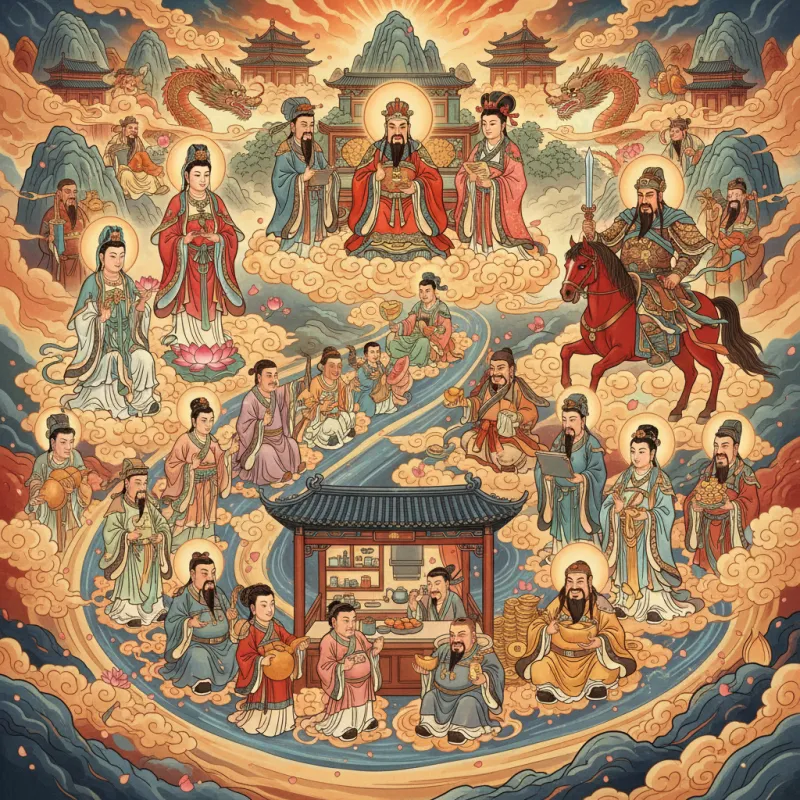
Your grandmother doesn't pray to the Jade Emperor. She doesn't meditate on the Dao. When she lights incense at the neighborhood temple, she's asking Guanyin to help your cousin pass the gaokao, begging Tudi Gong to protect the family business, and thanking Caishen for last month's windfall. This is Chinese folk religion (民间信仰, mínjiān xìnyǎng) — the actual spiritual practice of hundreds of millions of people, and it looks nothing like what you read in academic books.
The Religion Nobody Talks About
Western scholars love discussing the "Three Teachings" (三教, sānjiào) — Daoism, Buddhism, and Confucianism. They write thick books about philosophical concepts, monastic traditions, and imperial rituals. Meanwhile, your grandmother is at the temple burning joss paper for the Kitchen God (灶神, Zàoshén), who reports on her family's behavior to heaven every New Year. She doesn't care which teaching he belongs to. She cares that he might snitch.
Folk religion is pragmatic, syncretic, and utterly unconcerned with doctrinal purity. It absorbs deities from Buddhism, Daoism, local legends, and historical figures without worrying about theological consistency. The pantheon is crowded, chaotic, and constantly evolving. New gods appear when communities need them. Old gods fade when they stop delivering results.
This isn't some primitive superstition that educated people have abandoned. Walk through any Chinese city and you'll find temples packed with professionals in business suits, students before exams, and elderly women who've been coming for sixty years. Folk religion persists because it works — not in a supernatural sense, but as a social technology for managing uncertainty, building community, and maintaining cultural continuity.
Guanyin: The Deity Who Does Everything
If you only know one name from Chinese folk religion, it's probably Guanyin (观音, Guānyīn) — the Goddess of Mercy. She is the most widely worshipped deity in China, and her job description is essentially "everything." Health problems? Guanyin. Can't get pregnant? Guanyin. Worried about your son's safety on a business trip? Guanyin. Need rain for your crops? Also Guanyin.
The fascinating part is that Guanyin started as Avalokitesvara, a male bodhisattva in Indian Buddhism. Somewhere between the Tang and Song dynasties, Chinese folk religion performed a sex change. The reasons are debated — some scholars point to the influence of indigenous mother goddesses, others to the association of compassion with feminine qualities in Chinese culture. What's undeniable is that the transformation stuck. By the Ming dynasty, Guanyin was definitively female in popular imagination, often depicted in flowing white robes holding a willow branch and a vase of pure water.
Her most popular form is Songzi Guanyin (送子观音, Sòngzǐ Guānyīn) — "Guanyin Who Brings Children." Women struggling with infertility pray to her, sometimes for years. When they finally conceive, they return to thank her and often donate money for temple repairs. This transactional relationship is typical of folk religion. Deities are expected to deliver results. If they don't, worshippers might switch to a different god.
Guanyin's temples are everywhere — from elaborate Buddhist monasteries to tiny roadside shrines. She appears in homes, restaurants, and taxi dashboards. Her image is so ubiquitous that many Chinese people don't even think of her as specifically Buddhist. She's just Guanyin, the one who helps.
The Bureaucratic Pantheon
Chinese folk religion organizes its deities like an imperial bureaucracy, because that's the organizational model everyone understood. Heaven has departments, hierarchies, and paperwork. Gods have specific jurisdictions and report to superiors. This isn't metaphor — it's how people actually conceptualize the divine realm.
The Jade Emperor (玉皇大帝, Yùhuáng Dàdì) sits at the top as the celestial CEO, but most people rarely pray to him directly. You don't bother the emperor with small problems. Instead, you petition the relevant department head. Need money? That's Caishen (财神, Cáishén), the God of Wealth. Sick child? Try Baosheng Dadi (保生大帝, Bǎoshēng Dàdì), the Great Emperor Who Protects Life. Legal troubles? Chenghuang (城隍, Chénghuáng), the City God, handles judicial matters in the afterlife.
The Kitchen God (Zaoshen) is the divine equivalent of a neighborhood watch captain. He lives in your kitchen and observes everything your family does all year. On the 23rd day of the 12th lunar month, he ascends to heaven to file his annual report. Families traditionally smear honey on his lips before he leaves — either to sweeten his words or to stick his mouth shut, depending on who you ask. This is folk religion in a nutshell: treating gods like bureaucrats you can bribe.
Tudi Gong (土地公, Tǔdì Gōng), the Earth God, manages even smaller territories — sometimes just a single neighborhood or village. He's the deity of local affairs, protecting residents and ensuring prosperity. His temples are modest, often just small shrines at street corners, but he's deeply loved. People bring him offerings of tea, fruit, and cigarettes. Yes, cigarettes. Some worshippers light them and place them in front of his statue so he can enjoy a smoke. The logic is impeccable: if you were a minor bureaucrat stuck managing a small territory for eternity, you'd want cigarettes too.
Mazu: The Goddess Who Conquered the Sea
Mazu (妈祖, Māzǔ) is proof that folk religion creates new gods when communities need them. She was a real person — Lin Moniang (林默娘, Lín Mòniáng), born in 960 CE on Meizhou Island in Fujian Province. According to legend, she had shamanic abilities and could predict weather patterns. She died young, around age 28, reportedly while trying to save her father and brothers from a storm at sea.
After her death, fishermen began reporting visions of a woman in red robes who appeared during storms to guide ships to safety. Her cult spread along the coast, carried by sailors and merchants. By the Song dynasty, she was receiving official recognition from the imperial court. By the Qing dynasty, she had been promoted multiple times in the celestial bureaucracy, accumulating increasingly grandiose titles.
Today, Mazu is one of the most important deities in southern China and Taiwan. Her largest temple in Taiwan, the Dajia Mazu Temple, hosts an annual pilgrimage that draws millions. The procession covers over 300 kilometers and lasts nine days. This isn't ancient tradition — it's living religion, adapting to modern transportation and media coverage while maintaining its essential character.
Mazu's story illustrates how folk religion works. A community faces a specific problem (dangerous sea voyages). A figure emerges who seems to help (Lin Moniang's weather predictions). After death, she becomes a deity who addresses that specific need (protecting sailors). Her cult spreads through networks of people who share that need (coastal trading communities). Eventually, she's absorbed into the official pantheon and gains broader powers.
The Immortals Next Door
Folk religion doesn't draw sharp lines between gods, immortals (仙, xiān), ghosts, and ancestors. The categories blur and overlap. Some deities started as humans who achieved immortality through cultivation, like Lü Dongbin, one of the Eight Immortals. Others were always divine. Still others are historical figures who were deified after death, like Guan Yu (关羽, Guān Yǔ), the Three Kingdoms general who became Guan Gong (关公, Guān Gōng), god of war, loyalty, and — somehow — wealth.
Guan Gong's transformation is particularly instructive. He died in 220 CE as a military commander. By the Song dynasty, he was being worshipped as a protector deity. The Ming novel Romance of the Three Kingdoms cemented his image as the epitome of loyalty and righteousness. Today, he's everywhere — police stations, triad headquarters, restaurants, and accountants' offices all display his statue. He protects cops and criminals with equal enthusiasm, because folk religion doesn't care about your moral contradictions.
The flexibility extends to how people worship. Your grandmother might pray to Guanyin at a Buddhist temple in the morning, burn incense for her ancestors at home in the afternoon, and consult a Daoist priest about feng shui in the evening. She doesn't see this as inconsistent. Each practice serves a different purpose. Buddhism offers compassion and karmic merit. Ancestor worship maintains family bonds across death. Daoism provides practical techniques for managing qi and fortune.
Why Folk Religion Survives
Folk religion persists because it's useful. It provides community gathering spaces, ritual frameworks for life transitions, and psychological comfort in uncertain times. When your grandmother prays to Guanyin before your surgery, she's not necessarily expecting a miracle. She's doing something concrete to manage her anxiety, participating in a tradition that connects her to her mother and grandmother, and activating a social network of fellow worshippers who will support your family.
The temples themselves serve crucial social functions. They're community centers where people exchange information, form business connections, and organize mutual aid. Temple festivals bring neighborhoods together. Donations to temples signal social status and civic responsibility. The religious aspects are inseparable from the social infrastructure.
Modern China's relationship with folk religion is complicated. The Communist Party officially promotes atheism and has demolished many temples. But folk religion is too deeply embedded in daily life to eliminate. Local governments often tolerate or even support temples because they boost tourism and maintain social stability. The result is a pragmatic accommodation: practice your folk religion, but don't call it religion. Call it "cultural heritage" or "traditional customs."
This semantic game actually fits folk religion perfectly. It's never been about doctrine or theology. It's about practice, community, and getting help with life's problems from whatever source works. Your grandmother doesn't need a systematic theology. She needs Guanyin to watch over her grandchildren, Tudi Gong to protect her neighborhood, and Caishen to keep the family business afloat. The gods deliver, or they don't. Either way, she'll be back at the temple next month, because that's what her grandmother did, and her grandmother before that.
The incense smoke rises, the joss paper burns, and the gods — bureaucratic, practical, and utterly Chinese — continue their work.
Related Reading
- The Kitchen God: Heaven's Spy in Every Chinese Home
- City Gods: Divine Bureaucrats of the Underworld
- Caishen: The God of Wealth and How to Welcome Prosperity
- Unveiling the Rich Tapestry of Chinese Deities and Immortals in Folk Religion
- The Earth God: Your Neighborhood Deity
- Types of Immortals (仙): A Classification Guide
- Unveiling the Mystique of Chinese Animal Spirits in Daoist and Buddhist Beliefs
- Ox-Head and Horse-Face: The Underworld's Enforcers