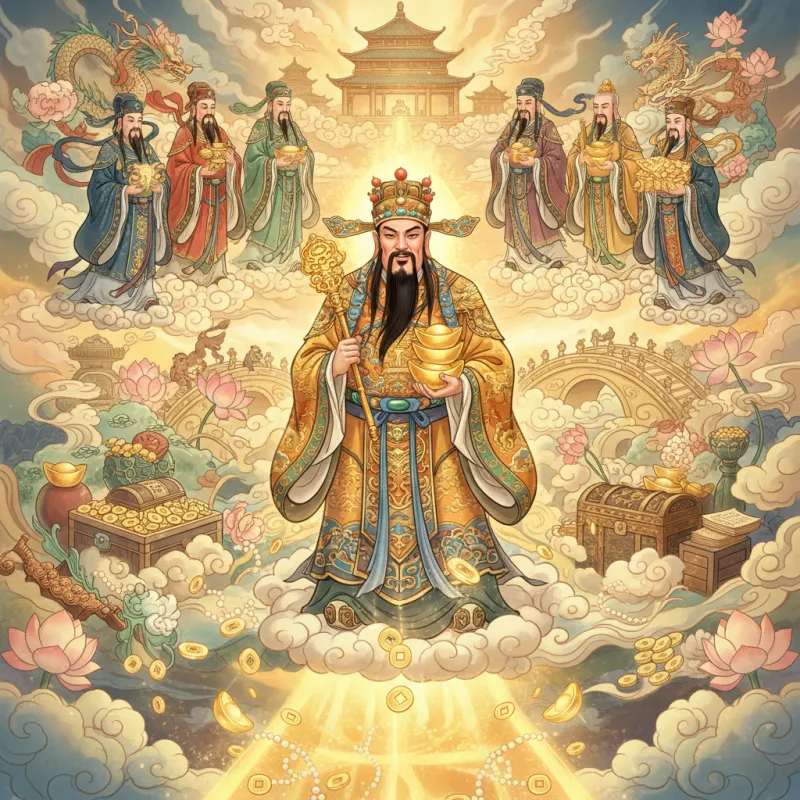
Every Lunar New Year, millions of Chinese families perform the same ritual: they open their doors at the stroke of midnight on the fifth day, light incense, and shout "Caishen dao!" (财神到 Cáishén dào — "The God of Wealth has arrived!"). They're not greeting an abstract concept. They're welcoming a specific deity with a face, a history, and very particular preferences about how he likes to be honored. And unlike the lofty Jade Emperor or the compassionate Guanyin, Caishen doesn't care much about your spiritual cultivation. He cares whether you're ready to receive prosperity.
The God Who Answers the Most Honest Prayer
Caishen (财神 Cáishén), the God of Wealth, occupies a unique position in the Chinese pantheon. While Guanyin embodies mercy and the Jade Emperor rules with cosmic authority, Caishen addresses what most people actually pray for: money. This isn't shallow — it's honest. In traditional Chinese culture, wealth enables you to fulfill your deepest obligations: caring for aging parents, educating children, making proper ancestral offerings, and supporting your community. Poverty doesn't make you virtuous; it makes you unable to be filial.
This is why Caishen appears everywhere. Walk into any Chinese restaurant, shop, or home, and you'll likely find his image — a bearded figure in official robes, often holding a gold ingot or a scroll that reads "招财进宝" (zhāo cái jìn bǎo — "Attract wealth and treasures"). He's not hidden in temples. He's on the cash register, facing the door, doing his job.
Five Gods, One Title
Here's where it gets complicated: "Caishen" isn't one deity. It's a title held by at least five different figures, each with their own origin story and specialty. The most prominent is Zhao Gongming (赵公明 Zhào Gōngmíng), a Daoist immortal who appears in the Ming dynasty novel Fengshen Yanyi (封神演义 Fēngshén Yǎnyì — "Investiture of the Gods"). In the novel, Zhao was a powerful cultivator who fought on the losing side of a cosmic war. After his death, the Jade Emperor appointed him Marshal of the Celestial Altar and God of Wealth — a promotion that turned a defeated warrior into the most popular deity in China.
Then there's Bi Gan (比干 Bǐ Gān), a historical figure from the Shang dynasty who served as a minister under the tyrant King Zhou. When Bi Gan criticized the king's cruelty, Zhou had him executed and his heart cut out. The logic of his deification is peculiar but perfect: a man without a heart cannot be partial or biased, making him the ideal god to distribute wealth fairly. This version of Caishen is called the "Civil God of Wealth" (文财神 Wén Cáishén) and is particularly popular among scholars and officials.
The "Martial God of Wealth" (武财神 Wǔ Cáishén) is often identified with Guan Yu (关羽 Guān Yǔ), the legendary general from the Three Kingdoms period. Guan Yu's association with wealth came later, through his reputation for integrity and loyalty — qualities that merchants valued. By the Qing dynasty, he had become the patron saint of business, his temples doubling as informal banks where merchants sealed deals.
There are also regional variations: in some areas, the Five-Way Gods of Wealth (五路财神 Wǔlù Cáishén) are worshipped as a collective, representing prosperity from all directions. The diversity reflects a practical theology: different people need different kinds of wealth, so why not have specialists?
The Ritual Calendar of Prosperity
Caishen worship follows a precise calendar. The most important date is the fifth day of the first lunar month, known as "Po Wu" (破五 Pò Wǔ — "Breaking Five"). This is when Caishen makes his annual rounds, visiting homes to distribute fortune for the coming year. Families prepare by cleaning their houses thoroughly — not just for tidiness, but to sweep away last year's bad luck and make room for new prosperity.
The ritual itself is specific. At midnight, the head of household opens all doors and windows, lights incense and firecrackers, and places offerings of fruit, meat, and wine on the altar. Some families prepare five plates of dumplings, representing the Five-Way Gods of Wealth. The key moment is the shout: "Caishen dao!" You're not asking him to come — you're announcing his arrival, as if his presence is inevitable and you're simply acknowledging it.
But Caishen isn't only honored once a year. The first and fifteenth of each lunar month are traditional worship days. Business owners burn incense before opening their shops. Gamblers pray before placing bets. Stock traders keep his image near their computers. This isn't superstition in the dismissive sense — it's a ritual acknowledgment that prosperity requires both effort and fortune, and you'd be foolish to neglect either.
What Caishen Actually Wants
The offerings matter. Caishen has preferences, and getting them wrong is like showing up to a job interview in pajamas. He likes gold and red — colors of prosperity and good fortune. He appreciates fresh fruit, especially oranges and tangerines, whose Chinese names sound like "luck" and "gold." He wants meat and wine, not the vegetarian offerings you'd give to Guanyin. He's a martial deity, a former warrior, and he expects to be treated accordingly.
The placement of his image is crucial. He should face the main door, positioned to see wealth entering the home or business. Never place him in a bathroom or bedroom — these are inauspicious locations that insult his dignity. Some families keep two images: Zhao Gongming facing outward to attract wealth, and Bi Gan facing inward to protect what's already accumulated.
But here's what matters most: Caishen rewards action. He's not a god of passive wishing. The traditional saying goes, "人勤财神爱" (rén qín cáishén ài — "The God of Wealth loves the diligent"). You can burn all the incense you want, but if you're lazy or dishonest in business, Caishen will pass your door. He's a god of prosperity, not charity. He amplifies what you're already doing, multiplies your efforts, opens opportunities — but you have to be working in the first place.
The Philosophy Behind the Practice
Western observers sometimes dismiss Caishen worship as materialistic, missing the deeper framework. In Chinese thought, wealth is not opposed to spirituality — it's a prerequisite for it. The Confucian concept of "修身齐家治国平天下" (xiū shēn qí jiā zhì guó píng tiānxià — "Cultivate yourself, regulate your family, govern the state, bring peace to the world") assumes you have the resources to do these things. You can't cultivate yourself if you're starving. You can't regulate your family if you can't feed them. Poverty isn't noble — it's an obstacle to virtue.
This is why Caishen worship cuts across all social classes and religious boundaries. Daoist temples honor him as an immortal. Buddhist temples include him in their pantheon despite Buddhism's emphasis on non-attachment. Confucian scholars kept his image despite their focus on moral cultivation. Even Communist officials, officially atheist, often have a Caishen figure tucked away somewhere. He's too useful to abandon.
The psychology is sound. Having a ritual for welcoming prosperity creates a mindset of abundance rather than scarcity. It's a form of positive visualization backed by thousands of years of cultural practice. When you clean your house for Caishen's arrival, you're literally and metaphorically making space for new opportunities. When you announce "Caishen dao!" you're affirming that prosperity is coming, training your mind to recognize and seize opportunities when they appear.
Modern Adaptations
Caishen has adapted remarkably well to contemporary life. In Hong Kong and Taiwan, his birthday (the fifth day of the first lunar month) sees stock traders flooding temples to pray for market gains. In mainland China, despite decades of official atheism, Caishen images have returned to shops and restaurants. Online, there are apps that send you Caishen blessings and digital red envelopes on auspicious days.
The imagery has evolved too. Traditional Caishen holds a gold ingot; modern versions might hold a smartphone or credit card. Some depictions show him riding a tiger or dragon, symbols of power and good fortune. The most popular contemporary image shows him with a broad smile, one hand raised in blessing, the other holding a scroll — approachable but authoritative, like a wealthy uncle who might help you out if you impress him.
Even the language has adapted. "Caishen" has become a casual term for anyone who brings financial opportunity. If a friend introduces you to a lucrative business contact, you might call them your "caishen." The phrase "抱财神大腿" (bào cáishén dàtuǐ — "hug the God of Wealth's thigh") means to attach yourself to someone wealthy and influential. The deity has become a metaphor, but the metaphor still carries his image.
The Invitation That Never Expires
What makes Caishen endure is his accessibility. You don't need a priest to mediate. You don't need to understand complex theology. You don't need to be particularly virtuous — just diligent and honest in your work. The barrier to entry is low: some fruit, some incense, a sincere invitation. The promise is straightforward: work hard, honor the god, and prosperity will find you.
This is why, every Lunar New Year, millions of doors open at midnight. Why incense smoke rises from countless altars. Why the shout "Caishen dao!" echoes through neighborhoods from Beijing to San Francisco. It's not blind superstition. It's a ritual acknowledgment of a truth that transcends culture: prosperity requires both effort and fortune, and while you can control the first, you'd be wise to invite the second. Caishen is waiting at your door. The question is whether you're ready to welcome him in.
Related Reading
- Exploring Chinese Deities and Immortals: Insights into Daoist and Buddhist Folk Gods
- City Gods: Divine Bureaucrats of the Underworld
- Unveiling the Rich Tapestry of Chinese Deities and Immortals in Folk Religion
- The Kitchen God: Spy of Heaven
- The City God System: Local Government of the Spirit World
- Lü Dongbin: The Most Beloved Immortal in Chinese Culture
- Dragon Worship in China: The Most Powerful Animal Deity
- The Jade Emperor: Ruler of Heaven