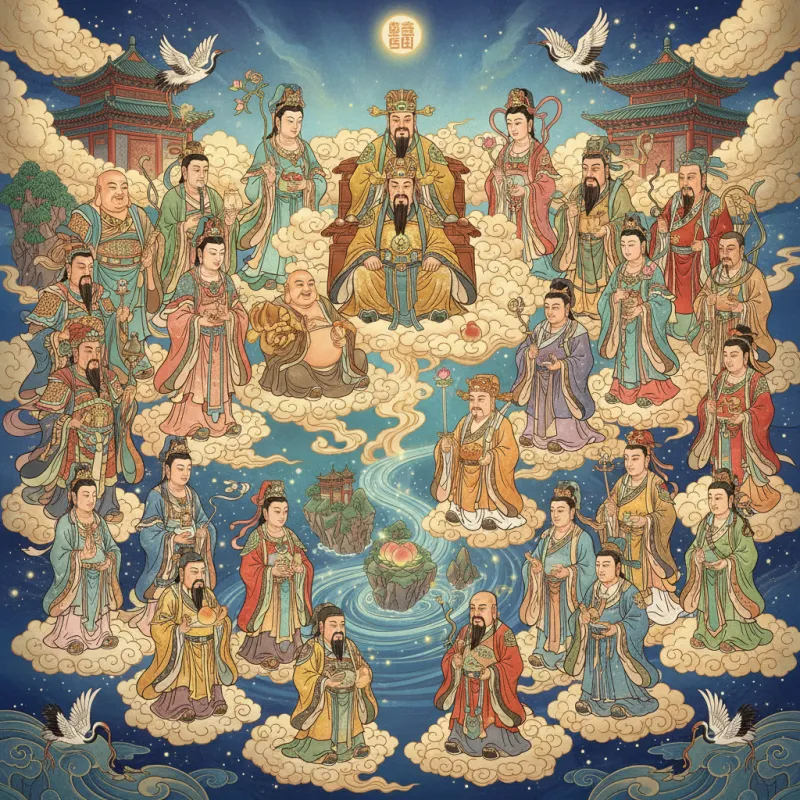
When the Jade Emperor's celestial bureaucracy needed a new god of wealth, they didn't hold elections — they promoted a mortal merchant who'd achieved enlightenment through generosity. This perfectly captures how Chinese folk religion works: it's less a fixed theology than a living, breathing system where deities earn their positions through merit, mortals can become immortals, and Buddhist bodhisattvas share temple space with Daoist thunder gods without anyone batting an eye.
The Great Merger: How Three Traditions Became One
Walk into any Chinese temple and you'll witness something that would give Western theologians a headache: Guanyin (觀音, Guānyīn), the Buddhist goddess of mercy, standing beside Guan Yu (關羽, Guān Yǔ), a deified general from the Three Kingdoms period, while Daoist immortals float on clouds painted across the ceiling. This isn't confusion — it's sanjiao heyi (三教合一, sānjiào héyī), the "unity of three teachings" that emerged during the Tang Dynasty (618-907 CE) and solidified under the Song (960-1279 CE).
The syncretism wasn't accidental. When Buddhism arrived in China during the Han Dynasty, it didn't conquer — it adapted. Buddhist missionaries translated Sanskrit terms using Daoist vocabulary, calling nirvana wuwei (無為, wúwéi) and comparing the Buddha to Laozi. By the time folk religion absorbed both traditions, ordinary Chinese people saw no contradiction in praying to the Buddha for enlightenment, asking the Jade Emperor for justice, and consulting the Eight Immortals for practical life advice.
The Celestial Bureaucracy: Heaven Runs on Paperwork
Chinese heaven operates like an imperial government, complete with departments, promotions, and performance reviews. The Jade Emperor (玉皇大帝, Yùhuáng Dàdì) sits at the top, but he's more administrator than omnipotent creator. Below him, gods manage specific portfolios: Wenchang (文昌, Wénchāng) oversees examinations and scholarly success, while Mazu (媽祖, Māzǔ) protects sailors and fishermen along the coast.
This bureaucratic model reflects Confucian political philosophy more than Daoist mysticism or Buddhist cosmology. When a community needed divine intervention, they didn't just pray — they filed petitions. Temple rituals often involved burning paper memorials addressed to specific deities, complete with formal titles and proper administrative channels. If the Kitchen God (灶神, Zàoshén) reported your family's misdeeds to the Jade Emperor during his annual trip to heaven, you could theoretically appeal the decision through ritual offerings and moral reform.
The system even allowed for promotions. Guan Yu started as a historical general who died in 220 CE, became a guardian spirit, got promoted to god of war, and eventually received the title "Emperor Guan" (關帝, Guān Dì) during the Ming Dynasty. His temples outnumber those of almost any other deity, and he's worshipped by everyone from police officers to triad members — both seeking his protection and sense of righteous loyalty.
Immortals vs. Gods: The Daoist Path to Divinity
Here's where it gets interesting: in Daoist tradition, you don't need to be born divine. The xian (仙, xiān) — immortals — achieved their status through cultivation practices, alchemical experiments, and spiritual refinement. They represent the ultimate Daoist promise: humans can transcend mortality through effort and understanding.
The most famous immortals are the Ba Xian, each representing a different social class and path to enlightenment. Lü Dongbin (呂洞賓, Lǚ Dòngbīn), a Tang Dynasty scholar, achieved immortality after meeting a mysterious figure in a wine shop who taught him sword techniques and alchemical secrets. He Xiangu (何仙姑, Hé Xiāngū), the only female among the eight, became immortal by eating powdered mica and moonbeams — a practice that sounds poetic until you remember that Daoist alchemists actually consumed mineral compounds, sometimes with fatal results.
The immortals inhabit a different realm than the bureaucratic gods. They're tricksters, wanderers, and teachers who appear in disguise to test mortals' virtue. In Journey to the West, they constantly interfere with the pilgrims' quest, sometimes helping, sometimes hindering, always teaching lessons through indirect means. This reflects the Daoist preference for spontaneity and natural wisdom over rigid hierarchies.
Buddhist Bodhisattvas: Compassion in Chinese Form
When Buddhism entered China, its bodhisattvas — enlightened beings who delay nirvana to help others — underwent remarkable transformations. Avalokiteśvara, originally depicted as male in Indian Buddhism, became Guanyin, the goddess of mercy whose image appears in nearly every Chinese household. This gender shift happened gradually between the Tang and Song dynasties, possibly influenced by the Daoist Queen Mother of the West (西王母, Xīwángmǔ) and folk desires for a maternal divine figure.
Guanyin's Chinese incarnation demonstrates how folk religion prioritizes practical benefits over theological purity. She grants children to the childless, saves sailors from shipwrecks, and appears in thirty-three different forms to meet people's needs. Her thousand arms and eyes symbolize her ability to see all suffering and reach everyone who calls her name — a visual metaphor that resonates more powerfully than abstract Buddhist philosophy about emptiness and dependent origination.
Dizang (地藏, Dìzàng), the Chinese form of Kṣitigarbha, took on an even more dramatic role. In Chinese Buddhism, he vowed not to achieve Buddhahood until all hells are empty — essentially making him the patron saint of lost causes and the dead. His cult became intertwined with ancestor worship and the Ghost Festival, showing how Buddhist concepts merged with indigenous Chinese concerns about filial piety and caring for deceased relatives.
Local Gods and Regional Variations
The real diversity in Chinese folk religion appears at the local level, where every region has its own protective deities and origin stories. In Fujian province, Mazu dominates as the sea goddess who saved her father and brothers from drowning using her spiritual powers. Her cult spread with Chinese maritime trade, and today she has temples from Taiwan to San Francisco's Chinatown.
Northern China venerates different figures. In Beijing, the City God (城隍, Chénghuáng) holds more importance, serving as the spiritual magistrate who judges souls and protects urban populations. Each city has its own City God, often a historical figure who served the community well in life. This localization means that Chinese folk religion isn't monolithic — it's a federation of regional practices united by common themes and overlapping pantheons.
Even individual professions developed patron deities. Carpenters worship Lu Ban (魯班, Lǔ Bān), a legendary craftsman from the Spring and Autumn period. Actors pray to the Tang Emperor Xuanzong, who loved theater. This specificity reveals how Chinese folk religion functions as a practical system for navigating life's challenges rather than an abstract theological framework.
The Living Tradition: Folk Religion Today
Despite decades of modernization and political campaigns against "superstition," Chinese folk religion persists. Temples across Taiwan, Hong Kong, and Southeast Asian Chinese communities maintain elaborate festivals where gods are paraded through streets, mediums channel divine messages, and communities reaffirm their connections to tradition. Even in mainland China, temple restoration and religious tourism have revived practices that seemed extinct during the Cultural Revolution.
The pantheon continues evolving. Some communities have begun venerating modern figures — there are rumors of temples to Guan Yu's spiritual successor among business leaders, and folk shrines to revolutionary martyrs that blend political ideology with traditional religious forms. This adaptability has always been Chinese folk religion's strength: it absorbs new elements while maintaining core practices of reciprocity, moral cultivation, and community cohesion.
What makes Chinese deities and immortals endlessly fascinating isn't their supernatural powers or elaborate mythologies — it's how they reflect human concerns across centuries. They're not distant, perfect beings demanding worship, but partners in the ongoing project of living ethically, protecting communities, and seeking transcendence. Whether you're burning incense to Guanyin for a sick relative or studying Daoist texts about immortality techniques, you're participating in a tradition that sees the divine and human realms as intimately connected, constantly negotiating, and ultimately inseparable.
Related Reading
- Guanyin: The God Who Became a Goddess (And Why Nobody Minds)
- The City God System: Local Government of the Spirit World
- Unveiling the Rich Tapestry of Chinese Deities and Immortals in Folk Religion
- City Gods: Divine Bureaucrats of the Underworld
- Caishen: The God of Wealth and How to Welcome Prosperity
- The Eight Immortals: China's Most Beloved Divine Group
- Unveiling the Rich Tapestry of Chinese Deities and Immortals
- Exploring the Rich Tapestry of Chinese Deities and Immortals